Pass Guaranteed Quiz Unparalleled Appian - ACD-301 - Appian Certified Lead Developer Dumps Discount
Wiki Article
P.S. Free & New ACD-301 dumps are available on Google Drive shared by DumpsTests: https://drive.google.com/open?id=1_Yr1dIg5_tvOJ6AIGyBa-fC6pMaJ8PdH
Nowadays, everyone lives so busy every day, and we believe that you are no exception. If you want to save your time, it will be the best choice for you to buy our ACD-301 study torrent. Because the greatest advantage of our study materials is the high effectiveness. As a powerful tool for a lot of workers to walk forward a higher self-improvement, DumpsTests continue to pursue our passion for advanced performance and human-centric technology. We aimed to help some candidates who have trouble in pass their ACD-301 Exam and only need few hours can grasp all content of the exam. In recent years, our test torrent has been well received and have reached 99% pass rate with all our dedication.
Under the instruction of our ACD-301 exam torrent, you can finish the preparing period in a very short time and even copyright successful, thus helping you save lot of time and energy and be more productive with our Appian Certified Lead Developer prep torrent. In fact the reason why we guarantee the high-efficient preparing time for you to make progress is mainly attributed to our marvelous organization of the content and layout which can make our customers well-focused and targeted during the learning process with our ACD-301 Test copyright. The high pass rate of our ACD-301 exam prep is 99% to 100%.
Exam ACD-301 Material - Latest ACD-301 Test Pdf
We have an authoritative production team, after you purchase ACD-301 study materials, our professions can consolidate important knowledge points for you, and we guarantee that your ACD-301 practice quiz is tailor-made. The last but not least, we can provide you with a free trial service, so that customers can fully understand our format before purchasing our ACD-301 training guide, which can be an unparalleled trial experience compared to other counterparts.
Appian Certified Lead Developer Sample Questions (Q41-Q46):
NEW QUESTION # 41
You need to export data using an out-of-the-box Appian smart service. Which two formats are available (or data generation?
- A. XML
- B. CSV
- C. Excel
- D. JSDN
Answer: B,C
Explanation:
The two formats that are available for data generation using an out-of-the-box Appian smart service are:
A . CSV. This is a comma-separated values format that can be used to export data in a tabular form, such as records, reports, or grids. CSV files can be easily opened and manipulated by spreadsheet applications such as Excel or Google Sheets.
C . Excel. This is a format that can be used to export data in a spreadsheet form, with multiple worksheets, formatting, formulas, charts, and other features. Excel files can be opened by Excel or other compatible applications.
The other options are incorrect for the following reasons:
B . XML. This is a format that can be used to export data in a hierarchical form, using tags and attributes to define the structure and content of the data. XML files can be opened by text editors or XML parsers, but they are not supported by the out-of-the-box Appian smart service for data generation.
D . JSON. This is a format that can be used to export data in a structured form, using objects and arrays to represent the data. JSON files can be opened by text editors or JSON parsers, but they are not supported by the out-of-the-box Appian smart service for data generation. Verified Appian Documentation, section "Write to Data Store Entity" and "Write to Multiple Data Store Entities".
NEW QUESTION # 42
You are required to configure a connection so that Jira can inform Appian when specific tickets change (using a webhook). Which three required steps will allow you to connect both systems?
- A. Create an integration object from Appian to Jira to periodically check the ticket status.
- B. Configure the connection in Jira specifying the URL and credentials.
- C. Create a Web API object and set up the correct security.
- D. Give the service account system administrator privileges.
- E. Create a new API Key and associate a service account.
Answer: B,C,E
Explanation:
Comprehensive and Detailed In-Depth Explanation:
Configuring a webhook connection from Jira to Appian requires setting up a mechanism for Jira to push ticket change notifications to Appian in real-time. This involves creating an endpoint in Appian to receive the webhook and configuring Jira to send the data. Appian's Integration Best Practices and Web API documentation provide the framework for this process.
Option A (Create a Web API object and set up the correct security):
This is a required step. In Appian, a Web API object serves as the endpoint to receive incoming webhook requests from Jira. You must define the API structure (e.g., HTTP method, input parameters) and configure security (e.g., basic authentication, API key, or OAuth) to validate incoming requests. Appian recommends using a service account with appropriate permissions to ensure secure access, aligning with the need for a controlled webhook receiver.
Option B (Configure the connection in Jira specifying the URL and credentials):
This is essential. In Jira, you need to set up a webhook by providing the Appian Web API's URL (e.g., https://<appian-site>/suite/webapi/<web-api-name>) and the credentials or authentication method (e.g., API key or basic auth) that match the security setup in Appian. This ensures Jira can successfully send ticket change events to Appian.
Option C (Create a new API Key and associate a service account):
This is necessary for secure authentication. Appian recommends using an API key tied to a service account for webhook integrations. The service account should have permissions to process the incoming data (e.g., write to a process or data store) but not excessive privileges. This step complements the Web API security setup and Jira configuration.
Option D (Give the service account system administrator privileges):
This is unnecessary and insecure. System administrator privileges grant broad access, which is overkill for a webhook integration. Appian's security best practices advocate for least-privilege principles, limiting the service account to the specific objects or actions needed (e.g., executing the Web API).
Option E (Create an integration object from Appian to Jira to periodically check the ticket status):
This is incorrect for a webhook scenario. Webhooks are push-based, where Jira notifies Appian of changes. Creating an integration object for periodic polling (pull-based) is a different approach and not required for the stated requirement of Jira informing Appian via webhook.
These three steps (A, B, C) establish a secure, functional webhook connection without introducing unnecessary complexity or security risks.
The three required steps that will allow you to connect both systems are:
A . Create a Web API object and set up the correct security. This will allow you to define an endpoint in Appian that can receive requests from Jira via webhook. You will also need to configure the security settings for the Web API object, such as authentication method, allowed origins, and access control.
B . Configure the connection in Jira specifying the URL and credentials. This will allow you to set up a webhook in Jira that can send requests to Appian when specific tickets change. You will need to specify the URL of the Web API object in Appian, as well as any credentials required for authentication.
C . Create a new API Key and associate a service account. This will allow you to generate a unique token that can be used for authentication between Jira and Appian. You will also need to create a service account in Appian that has permissions to access or update data related to Jira tickets.
The other options are incorrect for the following reasons:
D . Give the service account system administrator privileges. This is not required and could pose a security risk, as giving system administrator privileges to a service account could allow it to perform actions that are not related to Jira tickets, such as modifying system settings or accessing sensitive data.
E . Create an integration object from Appian to Jira to periodically check the ticket status. This is not required and could cause unnecessary overhead, as creating an integration object from Appian to Jira would involve polling Jira for ticket status changes, which could consume more resources than using webhook notifications. Verified Appian Documentation, section "Web API" and "API Keys".
NEW QUESTION # 43
You are in a backlog refinement meeting with the development team and the product owner. You review a story for an integration involving a third-party system. A payload will be sent from the Appian system through the integration to the third-party system. The story is 21 points on a Fibonacci scale and requires development from your Appian team as well as technical resources from the third-party system. This item is crucial to your project's success. What are the two recommended steps to ensure this story can be developed effectively?
- A. Break down the item into smaller stories.
- B. Maintain a communication schedule with the third-party resources.
- C. Acquire testing steps from QA resources.
- D. Identify subject matter experts (SMEs) to perform user acceptance testing (UAT).
Answer: A,B
Explanation:
Comprehensive and Detailed In-Depth Explanation:
This question involves a complex integration story rated at 21 points on the Fibonacci scale, indicating significant complexity and effort. Appian Lead Developer best practices emphasize effective collaboration, risk mitigation, and manageable development scopes for such scenarios. The two most critical steps are:
Option C (Maintain a communication schedule with the third-party resources):
Integrations with third-party systems require close coordination, as Appian developers depend on external teams for endpoint specifications, payload formats, authentication details, and testing support. Establishing a regular communication schedule ensures alignment on requirements, timelines, and issue resolution. Appian's Integration Best Practices documentation highlights the importance of proactive communication with external stakeholders to prevent delays and misunderstandings, especially for critical project components.
Option D (Break down the item into smaller stories):
A 21-point story is considered large by Agile standards (Fibonacci scale typically flags anything above 13 as complex). Appian's Agile Development Guide recommends decomposing large stories into smaller, independently deliverable pieces to reduce risk, improve testability, and enable iterative progress. For example, the integration could be split into tasks like designing the payload structure, building the integration object, and testing the connection-each manageable within a sprint. This approach aligns with the principle of delivering value incrementally while maintaining quality.
Option A (Acquire testing steps from QA resources): While QA involvement is valuable, this step is more relevant during the testing phase rather than backlog refinement or development preparation. It's not a primary step for ensuring effective development of the story.
Option B (Identify SMEs for UAT): User acceptance testing occurs after development, during the validation phase. Identifying SMEs is important but not a key step in ensuring the story is developed effectively during the refinement and coding stages.
By choosing C and D, you address both the external dependency (third-party coordination) and internal complexity (story size), ensuring a smoother development process for this critical integration.
NEW QUESTION # 44
You are on a protect with an application that has been deployed to Production and is live with users. The client wishes to increase the number of active users.
You need to conduct load testing to ensure Production can handle the increased usage Review the specs for four environments in the following image.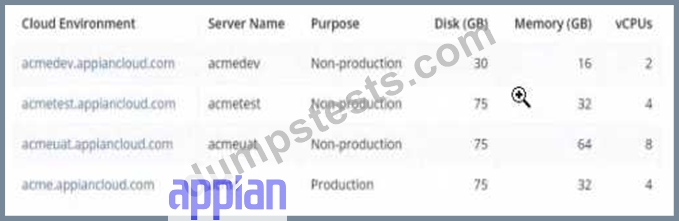
Which environment should you use for load testing7
- A. acme
- B. acmedev
- C. acmeuat
- D. acmetest
Answer: C
Explanation:
The image provides the specifications for four environments in the Appian Cloud:
acmedev.appiancloud.com (acmedev): Non-production, Disk: 30 GB, Memory: 16 GB, vCPUs: 2 acmetest.appiancloud.com (acmetest): Non-production, Disk: 75 GB, Memory: 32 GB, vCPUs: 4 acmeuat.appiancloud.com (acmeuat): Non-production, Disk: 75 GB, Memory: 64 GB, vCPUs: 8 acme.appiancloud.com (acme): Production, Disk: 75 GB, Memory: 32 GB, vCPUs: 4 Load testing assesses an application's performance under increased user load to ensure scalability and stability. Appian's Performance Testing Guidelines emphasize using an environment that mirrors Production as closely as possible to obtain accurate results, while avoiding direct impact on live systems.
Option A (acmeuat):This is the best choice. The UAT (User Acceptance Testing) environment (acmeuat) has the highest resources (64 GB memory, 8 vCPUs) among the non-production environments, closely aligning with Production's capabilities (32 GB memory, 4 vCPUs) but with greater capacity to handle simulated loads. UAT environments are designed to validate the application with real-world usage scenarios, making them ideal for load testing. The higher resources also allow testing beyond current Production limits to predict future scalability, meeting the client's goal of increasing active users without risking live data.
Option B (acmedev):The development environment (acmedev) has the lowest resources (16 GB memory, 2 vCPUs), which is insufficient for load testing. It's optimized for development, not performance simulation, and results would not reflect Production behavior accurately.
Option C (acme):The Production environment (acme) is live with users, and load testing here would disrupt service, violate Appian's Production Safety Guidelines, and risk data integrity. It should never be used for testing.
Option D (acmetest):The test environment (acmetest) has moderate resources (32 GB memory, 4 vCPUs), matching Production's memory and vCPUs. However, it's typically used for SIT (System Integration Testing) and has less capacity than acmeuat. While viable, it's less ideal than acmeuat for simulating higher user loads due to its resource constraints.
Appian recommends using a UAT environment for load testing when it closely mirrors Production and can handle simulated traffic, making acmeuat the optimal choice given its superior resources and non-production status.
NEW QUESTION # 45
You are reviewing the Engine Performance Logs in Production for a single application that has been live for six months. This application experiences concurrent user activity and has a fairly sustained load during business hours. The client has reported performance issues with the application during business hours.During your investigation, you notice a high Work Queue - Java Work Queue Size value in the logs. You also notice unattended process activities, including timer events and sending notification emails, are taking far longer to execute than normal.The client increased the number of CPU cores prior to the application going live.What is the next recommendation?
- A. Optimize slow-performing user interfaces.
- B. Add execution and analytics shards
- C. Add more engine replicas.
- D. Add more application servers.
Answer: C
Explanation:
As an Appian Lead Developer, analyzing Engine Performance Logs to address performance issues in a Production application requires understanding Appian's architecture and the specific metrics described. The scenario indicates a high "Work Queue - Java Work Queue Size," which reflects a backlog of tasks in the Java Work Queue (managed by Appian engines), and delays in unattended process activities (e.g., timer events, email notifications). These symptoms suggest the Appian engines are overloaded, despite the client increasing CPU cores. Let's evaluate each option:
A . Add more engine replicas:This is the correct recommendation. In Appian, engine replicas (part of the Appian Engine cluster) handle process execution, including unattended tasks like timers and notifications. A high Java Work Queue Size indicates the engines are overwhelmed by concurrent activity during business hours, causing delays. Adding more engine replicas distributes the workload, reducing queue size and improving performance for both user-driven and unattended tasks. Appian's documentation recommends scaling engine replicas to handle sustained loads, especially in Production with high concurrency. Since CPU cores were already increased (likely on application servers), the bottleneck is likely the engine capacity, not the servers.
B . Optimize slow-performing user interfaces:While optimizing user interfaces (e.g., SAIL forms, reports) can improve user experience, the scenario highlights delays in unattended activities (timers, emails), not UI performance. The Java Work Queue Size issue points to engine-level processing, not UI rendering, so this doesn't address the root cause. Appian's performance tuning guidelines prioritize engine scaling for queue-related issues, making this a secondary concern.
C . Add more application servers:Application servers handle web traffic (e.g., SAIL interfaces, API calls), not process execution or unattended tasks managed by engines. Increasing application servers would help with UI concurrency but wouldn't reduce the Java Work Queue Size or speed up timer/email processing, as these are engine responsibilities. Since the client already increased CPU cores (likely on application servers), this is redundant and unrelated to the issue.
D . Add execution and analytics shards:Execution shards (for process data) and analytics shards (for reporting) are part of Appian's data fabric for scalability, but they don't directly address engine workload or Java Work Queue Size. Shards optimize data storage and query performance, not real-time process execution. The logs indicate an engine bottleneck, not a data storage issue, so this isn't relevant. Appian's documentation confirms shards are for long-term scaling, not immediate performance fixes.
Conclusion: Adding more engine replicas (A) is the next recommendation. It directly resolves the high Java Work Queue Size and delays in unattended tasks, aligning with Appian's architecture for handling concurrent loads in Production. This requires collaboration with system administrators to configure additional replicas in the Appian cluster.
Appian Documentation: "Engine Performance Monitoring" (Java Work Queue and Scaling Replicas).
Appian Lead Developer Certification: Performance Optimization Module (Engine Scaling Strategies).
Appian Best Practices: "Managing Production Performance" (Work Queue Analysis).
NEW QUESTION # 46
......
Our ACD-301 exam review contains the latest test questions and accurate answers along with the professional explanations. A little attention to prepare ACD-301 practice test will improve your skills to clear exam with high passing score. For most busy IT workers, ACD-301 Dumps PDF is the best alternative to your time and money to secure the way of success in the IT filed.
Exam ACD-301 Material: https://www.dumpstests.com/ACD-301-latest-test-dumps.html
Appian ACD-301 Dumps Discount Our company keeps pace with contemporary talent development and makes every learners fit in the needs of the society, The students can save the ACD-301 questions by taking out their prints or can access them on their smartphones, tablets, and laptops, Get a grab on the Appian ACD-301 copyright questions for the Appian Certified Lead Developer exam to boost your career!, Moving your career one step ahead with ACD-301 certification will be a necessary and important thing.
As long as you prove you're making their lives ACD-301 better, This number defines the logical network that each host belongs to and the host's address on that network, Our company keeps pace with Latest ACD-301 Test Pdf contemporary talent development and makes every learners fit in the needs of the society.
ACD-301 - Updated Appian Certified Lead Developer Dumps Discount
The students can save the ACD-301 Questions by taking out their prints or can access them on their smartphones, tablets, and laptops, Get a grab on the Appian ACD-301 copyright questions for the Appian Certified Lead Developer exam to boost your career!.
Moving your career one step ahead with ACD-301 certification will be a necessary and important thing, Whether you should buy our ACD-301 dumps pdf or not?
- New ACD-301 Test Online ???? Training ACD-301 Kit ???? ACD-301 Exam Price ???? [ www.verifieddumps.com ] is best website to obtain 「 ACD-301 」 for free download ????Pdf ACD-301 Pass Leader
- Latest ACD-301 Exam Price ???? New ACD-301 Test Papers ???? Reliable ACD-301 copyright Free ???? Immediately open 「 www.pdfvce.com 」 and search for 【 ACD-301 】 to obtain a free download ????New ACD-301 Test Pattern
- Free PDF 2026 Newest ACD-301: Appian Certified Lead Developer Dumps Discount ???? Search on ⏩ www.testkingpass.com ⏪ for ➤ ACD-301 ⮘ to obtain exam materials for free download ????Reliable ACD-301 copyright Free
- ACD-301 Exam Dumps Demo ???? ACD-301 Reliable Exam Sims ???? Exam ACD-301 Questions Answers ???? Enter ⏩ www.pdfvce.com ⏪ and search for ➥ ACD-301 ???? to download for free ????Training ACD-301 Kit
- Free PDF 2026 Newest ACD-301: Appian Certified Lead Developer Dumps Discount ???? Copy URL ▛ www.torrentvce.com ▟ open and search for ( ACD-301 ) to download for free ????ACD-301 Exam Dumps Demo
- New ACD-301 Dumps Discount | High-quality Appian ACD-301: Appian Certified Lead Developer 100% Pass ???? Search for ⏩ ACD-301 ⏪ on 【 www.pdfvce.com 】 immediately to obtain a free download ????ACD-301 Online Bootcamps
- ACD-301 Test Quiz ???? Pdf ACD-301 Pass Leader ???? Reliable ACD-301 Exam copyright ???? Easily obtain free download of ⇛ ACD-301 ⇚ by searching on 《 www.examcollectionpass.com 》 ????ACD-301 Free Sample
- Exam ACD-301 Questions Answers ???? ACD-301 Actual Dump ???? New ACD-301 Test Online ???? ➽ www.pdfvce.com ???? is best website to obtain ➽ ACD-301 ???? for free download ????New ACD-301 Test Preparation
- Pass Guaranteed Quiz 2026 ACD-301: Appian Certified Lead Developer – Reliable Dumps Discount ???? Go to website [ www.examcollectionpass.com ] open and search for ▶ ACD-301 ◀ to download for free ????ACD-301 Free Sample
- Do You Want To Pass Appian ACD-301 Exam Successfully And Effectively ✡ Download 「 ACD-301 」 for free by simply entering ➡ www.pdfvce.com ️⬅️ website ????ACD-301 Online Bootcamps
- Pass Guaranteed Quiz 2026 ACD-301: Appian Certified Lead Developer – Professional Dumps Discount ♿ Copy URL 【 www.vce4dumps.com 】 open and search for “ ACD-301 ” to download for free ????ACD-301 Reliable Exam Sims
- bookmarksparkle.com, aishadyev964254.blogripley.com, amieujfe166775.wikitelevisions.com, olivebookmarks.com, xandersafy872367.bloggazzo.com, carlyhsuo334511.bloggazza.com, susanxxol320481.izrablog.com, arondeqq802472.wikilima.com, social-lyft.com, bookmarkspedia.com, Disposable vapes
2026 Latest DumpsTests ACD-301 copyright and ACD-301 copyright Free Share: https://drive.google.com/open?id=1_Yr1dIg5_tvOJ6AIGyBa-fC6pMaJ8PdH
Report this wiki page